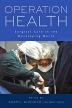
Making the case for global surgery is a book review in the Lancet by David A. Waters.
Operation Health is a slim volume but it makes a compelling case for surgery to be part of the global health agenda. This collection of essays by experts with impressive track records in global surgery highlights the plight of those who need surgical care in low-income and middle-income countries, where too many people do not get the care they need.
Perhaps two sentences, one at the start and one in the final chapter, sum up what this book aims to convey. First, Dr Reinou Groen begins with: “Without the relatively simple operation [for a strangulated inguinal hernia], the father of three and the main breadwinner of the family would certainly have died.” Second, Adam Kushner argues in the conclusion that “Only through organized efforts and support from the grassroots levels to international institutions will surgical care be recognized as necessary and deemed a political priority”.
Each of the book’s dozen chapters draws the reader in by opening with a story or case to engage interest before describing how, despite the scale of the tragedy of unmet need, there is much that can be done to treat those who reach hospital in time. The contributors bring evidence, expertise, and share their first-hand experience of what works in delivering surgical care in limited resource settings.
The first chapter makes clear that individuals who are out in the community, who might have little prospect of reaching surgical care, are at least being counted. To measure unmet need for surgical care, Surgeons Overseas (SOS) has developed a survey tool for the Assessment of Surgical Need (SOSAS). There is also a Personnel, Infrastructure, Procedures, Equipment, Supplies (PIPES) tool to assess capability and capacity.
Investment in surgical and anaesthesia care in low-income and middle-income countries will yield a large return worth many times the original investment made. The contributions in the book align to the Millennium Development Goals (MDGs). Development in global surgery will not take place without securing the health and wellbeing of women and children, the focus of two early chapters. Then there is a chapter relevant to MDG 6, on the role of surgery in the care of patients with HIV. Having worked in sub-Saharan Africa, I know that surgery plays a major part in both the treatment of HIV and its manifestations, but also that surgical presentations and responses to treatment are affected by HIV, not least when it comes to dual infection with tuberculosis.
Perhaps one of the greatest tragedies of how the MDGs were articulated was the way surgical care was overlooked. As the global community now looks beyond the MDGs, it is essential that universal access to safe, affordable surgical and anaesthesia care is recognised as an important part of the post-2015 health agenda. The omission of surgery has resulted in health systems continuing to fail, economies remaining laggard, a greater number of premature deaths, and much costly disability. Non-communicable diseases (NCDs) are on the rise and have globally overtaken communicable diseases in burden in some countries. Operation Health discusses the increasing role of NCDs in surgical care; in particular cancer, the incidence of which is projected to rise steeply by 2030. Also, low-income countries suffer a high case fatality rate for cancer, and often in the younger, more economically active age groups.
Operation Health also offers case studies of anaesthesia in Ghana and trauma management in Tanzania. Education and advocacy provided by orthopaedic and trauma institutes, such as the Institute of Global Orthopaedics and Traumatology (IGOT), raise awareness about the 5·1 million who die every year from trauma. Further case studies describe the appropriate introduction of laparoscopic cholecystectomy in Mongolia and improving processes for surgical care delivery in Ghana. Finally, in a chapter describing the challenge of training the next generation of surgeons and the education of medical students in sub-Saharan Africa, we are reminded that this is a region where the surgeon to population ratio is generally 0·1–0·7 per 100 000 people compared with the 30–40 per 100 000 people enjoyed by the UK and USA.
Kushner writes in conclusion “Surgical care must be recognised…in the treatment of conditions arising from both non-communicable and communicable diseases”. These conditions span congenital defects, complications of pregnancy, infections, injuries, abdominal conditions, degenerative diseases, and cancer. Surgical care is needed at all stages of life from birth, through reproductive years to the grave. He has weaved science, evidence, global surgery, and public health in a journalistic, readable style. In this 100 page passionate and compassionate account of the importance of surgery for global health, Kushner’s editing was as sharp as his scalpel, but with the hope of good surgical outcomes for all.

 Operation Health: A series of books on surgery and global health from Johns Hopkins University Press